Every few months someone emails asking whether we have a place that sleeps fourteen. We don't. What we have is two places about twelve minutes apart, and for a lot of groups that turns out to be the better answer — not the consolation prize.
Why one big house is often worse
A single large rental sounds simpler, and on the booking page it is. Then you get there and discover the things a floor plan doesn't tell you: one kitchen for fourteen people at breakfast, one set of bathrooms, the baby's nap schedule versus the teenagers' bedtime, and the relative who wants to read in silence sharing a wall with the ones playing cards.
Two households at twelve minutes' remove solves most of that by geometry. You still eat dinner together every night. You just don't negotiate the coffee maker.
What the two places are actually for
Sapphire Beach is the beach household. You walk out of the building onto the sand; the snorkel gear is in the closet; there's a pool and a grill. This is where the swimmers, the early risers, and anyone traveling with small kids should sleep, because "we're going to the beach" becomes a thirty-second operation rather than a convoy.
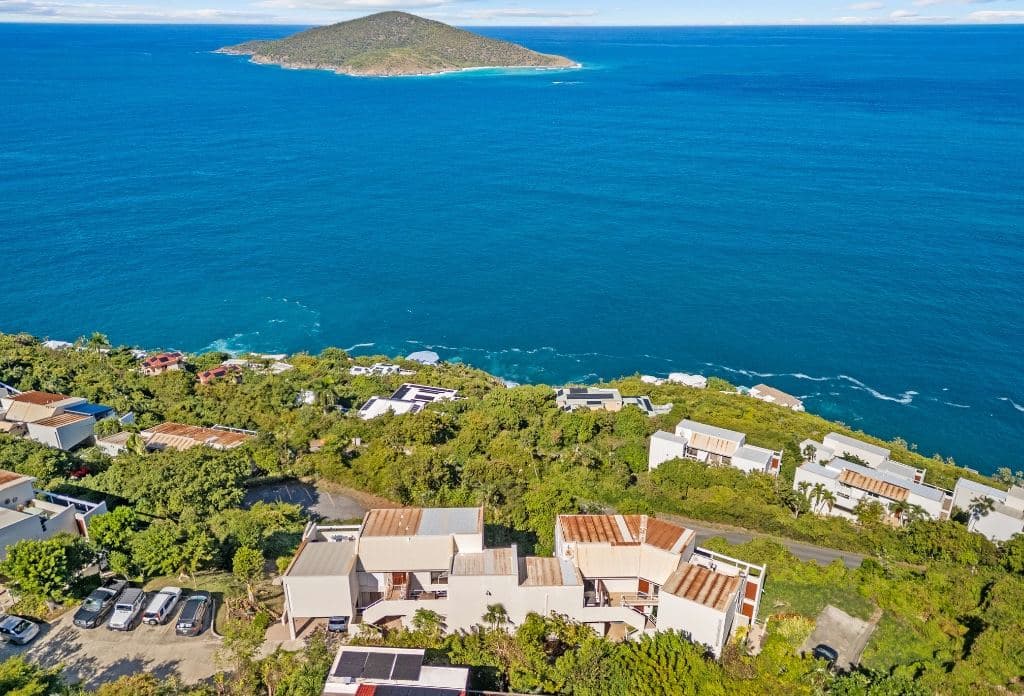
Mahogany Seaview is the view household. It's up in the hills on the north side, a few degrees cooler, with the deck and the panoramic water view that people photograph. There's resort-style pool access a short (steep) walk away rather than a pool at the door. This is where the people who want quiet, a long morning with coffee, and a sunset from a chair should sleep.
Same owners, same gear closets, same welcome guide, so nobody gets the worse half of the trip — they get a different half.
Making it work in practice
Pick one kitchen as the dinner kitchen. Both have full kitchens, but a group that tries to cook at both ends up eating separately. Sapphire's grill and beach-level access make it the easier host for a big table; Mahogany's deck is the better place to end a night.
Do the grocery run once, for both. Split the perishables at the door. Two half-full fridges beat one overflowing one.
Assume one car per household. They're twelve minutes apart on roads you don't want to be shuttling back and forth on after dark. Driving here is easier than people fear and slower than the map suggests.
Put the early risers at the beach. Someone in your group wants to be in the water at seven. Let them, without waking eight other people to do it.
Book both at once. Two places on the same dates take more coordination than one; the calendars don't always line up, and the closer to the date, the less likely they do.
When it doesn't work
If the whole point of the trip is that everyone is under one roof — a milestone birthday where the group being together is the event — then split accommodations will feel like a compromise, and you should book one large house somewhere else with our blessing.
It also doesn't work if only one household rents a car. The geometry that makes this good depends on both ends being able to move.
Who this is really for
Multigenerational trips, mostly: grandparents who want the view and the quiet, parents who want to be able to walk to the sand with a toddler, and a middle generation that wants both and would like a door between them and the other two. We wrote more about that shape of trip in the multigenerational guide.
If you're weighing it, tell us the group and the dates and we'll tell you honestly whether both places are free and which household should go where. Current open weeks at both are on the deals page.